
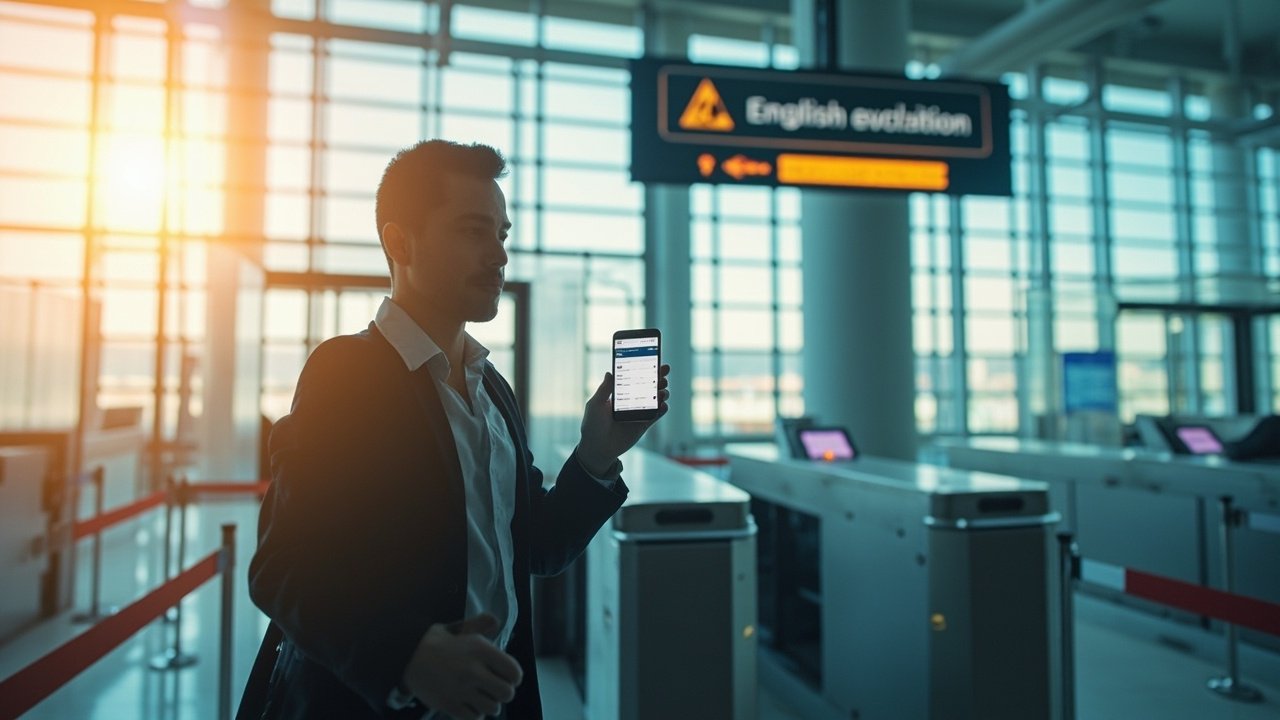
Navigating an airport security check can be a stressful moment in any journey. For English learners, that stress can double when you're trying to understand instructions, answer questions, and move your belongings through the scanner, all in a language you're still mastering. A confusing interaction can cause delays, increase anxiety, and put a damper on the start of your trip.
This isn't about passing an English exam; it's about practical, real-world communication. Learning the specific English used at the airport security check makes the process smoother, faster, and far less intimidating. You gain confidence, reduce your travel stress, and ensure you and your belongings get to the gate without unnecessary hassle. Let's look at some straightforward methods and tips to master this essential travel skill.
Understanding Airport Security Check English Vocabulary
Knowing the right words is like having a map in an unfamiliar city. At security, specific nouns and verbs are used repeatedly. Understanding them turns a stream of confusing sounds into clear instructions.
Essential Nouns for Airport Security
These are the things you'll encounter and need to name.
- Boarding Pass: Your ticket to get on the plane. You'll need to show it, often with your passport, at the first security checkpoint. *Example: \Please have your boarding pass and identification ready.*
- Carry-on (Bag) / Hand Luggage: The bag you take with you onto the airplane. *Example: \Please place all carry-on bags on the conveyor belt.*
- Conveyor Belt / X-ray Belt: The moving belt that takes your bags through the X-ray machine.
- X-ray Machine / Scanner: The large tunnel your bags go through.
- Security Tray / Bin: The plastic box you put your belongings in. *Example: \Please put your laptop in a separate bin.*
- Metal Detector / Body Scanner: The archway or booth you walk through for a personal scan.
- Liquids: This refers to your toiletries. Remember the common rule: containers must hold 100ml or less, and all must fit in one transparent, resealable 1-litre plastic bag. *Example: \Do you have any liquids in your bag?*
- Belt, Shoes, Jacket, Watch: Personal items you will often be asked to remove. *Example: \Please remove your belt, shoes, and any metal jewelry.*
Common Verbs in Security Procedures
These are the actions you will be asked to perform.
- To proceed: To go forward. *Example: \Please proceed to the next available agent.*
- To place / To put: To set something down. *Example: \Place your bag on the belt.*
- To remove: To take off. *Example: \Remove your laptop from its case.*
- To step through / To walk through: To go through the metal detector. *Example: \You may step through now.*
- To step aside: To move to the side for additional screening. *Example: \Sir, we need you to step aside for a moment.*
- To declare: To officially state you have something (often used for large amounts of cash or certain foods). *Example: \Do you have anything to declare?*
Having these words in your mental toolkit is the first major step. To see how they fit together, here’s a table of a typical security sequence.
| Step | Location | Key Nouns You'll See/Use | Key Verbs You'll Hear |
|---|---|---|---|
| 1. Document Check | Queue Entrance | Boarding Pass, ID/Passport | Show, Present, Proceed |
| 2. Preparing Belongings | Bench Area | Security Tray/Bin, Carry-on, Laptop, Liquids Bag | Place, Remove, Put |
| 3. Personal Screening | Metal Detector | Metal Detector, Archway, Scanner | Step Through, Walk Through, Wait |
| 4. Bag Inspection (if needed) | Secondary Screening Table | Carry-on, Contents | Open, Step Aside, Check |
Practical Phrases for Smooth Airport Security Interactions
Vocabulary is the toolbox, but phrases are the actual tools you use to build a smooth interaction. Here’s how to use them in common scenarios.
Responding to Security Officers
Your goal here is to be clear, concise, and cooperative.
- When asked about specific items:
- \Do you have any liquids?\ -> \Yes, they're in my liquids bag.** or \No, I don't.**
- \Is this your bag?\ -> \Yes, it is.** or \Yes, that's mine.**
- \Do you have a laptop in your bag?\ -> *\Yes, I'll take it out.* (Then do it immediately).
- If you don't understand:
- Use simple, polite phrases: \Could you repeat that, please?** or \I'm sorry, I didn't catch that.**
- Pointing is universal. You can say, \Here?** or \Like this?** while mimicking the action you think they want.
- If you are selected for additional screening:
- Stay calm and polite. You can say, \Okay, no problem.** or \What do you need me to do?**
Asking Questions in English
Don't be afraid to ask if you're unsure. It's better to ask than to do the wrong thing.
- Before you get to the front: \Do I need to take my shoes off?** or \Should my laptop go in a separate bin?**
- If you're confused about the process: \Should I go through now?** or \Is this the line for security?**
- If you need help: *\Could you help me with this tray, please?*
Tip on Tone: Security areas are busy and noisy. Speak clearly, but don't shout. A polite tone goes a long way. Using \please\ and \thank you\ is always appreciated, even in brief exchanges. A simple *\Thank you* as you collect your items is a good habit.
Learning Methods: How to Practice Airport Security Check English
Memorizing lists is a start, but to really remember and use this language under pressure, you need to practice actively. Passive learning won't cut it here.
Role-Playing Scenarios
This is the single most effective method. It prepares you for the real interaction.
- Write a Script: With a study partner or tutor, write a simple dialogue based on the table in the previous section.
- Practice Both Roles: Be the traveler and the security officer. Hearing and saying the phrases solidifies them.
- Add Variables: What if your bag gets flagged? What if you forgot to take your belt off? Role-play these minor hiccups so they don't fluster you in real life.
Listening Practice Tips
Your ear needs to get used to the announcements and instructions, which are often delivered over loudspeakers or in noisy environments.
- Find Authentic Audio: Search online for \airport security announcements\ or \TSA instructions.\ Many travel YouTube channels have real footage with clear audio.
- Active Listening: Don't just have it on in the background. Listen and write down the key commands you hear: \Place... remove... proceed...\3. Use Transcripts:* If available, listen first, then read the transcript to check your understanding. Then listen again.
Using Flashcards Effectively
Old-school but powerful, especially for vocabulary. Use physical cards or a digital app.
- Front of Card: The word (e.g., \conveyor belt\ or a phrase (\Please step aside.).
- Back of Card: The definition and a sample sentence in a security context. The visual and contextual connection boosts memory.
The methods above are solid, but you might run into common hurdles. Maybe finding a consistent practice partner for role-play is hard. Perhaps it's difficult to find structured listening exercises that start simple and get more challenging. You might wish your flashcards could include audio pronunciation for those tricky phrases.
So, what kind of tool could help bring these methods together in one place? Ideally, it would offer realistic, scripted dialogues for role-play, graded listening exercises with transcripts, and smart flashcards with native-speaker audio. It would allow you to practice independently, at your own pace, focusing specifically on practical scenarios like the airport security check.
Advanced Strategies for Mastering Travel English
Once you're comfortable with the security basics, you can build on that foundation for all your travel English needs.
Setting Realistic Learning Goals
\Get better at English\ is too vague. Try SMART goals:
- This Week: I will learn and be able to recall 15 key airport security check nouns and verbs.
- This Month: I will be able to confidently role-play the entire security process without hesitating on instructions.
- Before My Trip: I will listen to 30 minutes of airport announcement practice and understand 90% of the commands.
Using Technology for Practice
Integrate short, focused practice into your daily routine.
- Dedicate Time: Even 10-15 minutes daily is more effective than one long session per week.
- Mix Skills: Don't just do vocabulary one day and listening the next. A good practice session might involve a quick flashcard review, then a listening exercise, then repeating the phrases you heard out loud.
- Simulate Distraction: Practice your listening with a little background noise (like quiet music) to better simulate the airport environment.
Research on learning retention consistently shows that spaced repetition (reviewing material at increasing intervals) and active recall (trying to remember information without looking) are far more effective than passive re-reading. Modern language tools are often built around these very principles.
Real-Life Examples and Success Stories
Hearing from others who have been in your shoes can be incredibly motivating.
Case Study: A Business Traveler's Journey
Before: Carlos, an engineer from Mexico, dreaded business trips to the US. At security, he would get nervous, miss instructions, and often have to open his bag for inspection because he didn't understand \Please remove your large electronics.\ He felt embarrassed and stressed.
Method: He focused only on airport and travel English for one month before his next trip. He used role-play with a colleague and found an app with airport-specific dialogues. He practiced the exact phrases for declaring his laptop and toiletry bag.
After: On his next trip, he heard \Please remove large electronics.\ He immediately said, \Yes, my laptop is in this sleeve,\ and placed it in a bin. The officer simply nodded. The process was faster, and Carlos felt a huge wave of confidence. That confidence carried over into his taxi ride and hotel check-in.
Tips from Frequent Flyers
- *\Watch the People Ahead of You* This is a classic, practical tip. If you're unsure what to do, observe the two or three travelers in front of you. They are your real-time demonstration.
- *\Keep Your Answers Short* Security officers aren't looking for conversation. \Yes,\ \No,\ \Okay,\ and \Thank you\ are often all you need. Don't feel pressured to explain.
- *\Prepare Physically and Mentally* While in line, start getting ready: have your boarding pass in hand, think about what you need to remove (jacket, watch, belt). This mental rehearsal frees up your brain to focus on listening.
FAQ: Common Questions About Airport Security Check English
1. How can I learn airport security vocabulary quickly? Focus on the high-frequency words listed in the \Essential Nouns\ and \Common Verbs\ sections above. Don't try to learn every possible word. Use flashcards with images (a picture of a conveyor belt) and practice putting them into simple sentences immediately. \My bag is on the conveyor belt.*2. What if I panic and forget all my English at the checkpoint? This is normal. Have a backup plan. The most useful phrase you can memorize is: \One moment, please.* It gives you a few seconds to breathe and think. Pointing and using simple words (\Shoes? Off?\ is also perfectly acceptable. Officers see nervous travelers every day.
3. Are there different phrases used in different English-speaking countries? The core process and vocabulary are very similar globally due to international aviation standards. However, accents and some minor terms may differ (e.g., \hand luggage\ is more common in the UK, \carry-on\ in the US). Understanding the core concepts will let you adapt easily.
4. What are the best free resources for practicing airport English? YouTube is excellent. Search for \airport security dialogue practice\ or \TSA security process.\ You can also find scripts for airport announcements online. For vocabulary, many free flashcard websites let you create your own \Airport Security\ deck.
5. How long before my trip should I start practicing? Even a little practice is beneficial, but for solid confidence, aim for 2-3 weeks of consistent, short practice sessions (15-20 minutes a day). This gives you time to move the language from your short-term to your long-term memory.
Conclusion: Your Action Plan for Airport English Mastery
Mastering the English for an airport security check is a very achievable goal. It's a limited, high-impact set of language skills that pays off every time you travel. You've learned the key vocabulary, practical phrases, effective practice methods, and long-term strategies.
Here is your simple action plan to get started:
- This Week: Make a list or flashcard deck of the 20 most essential nouns and verbs from this article.
- Next Week: Find one YouTube video of a real airport security line. Listen three times: once for gist, once while reading a transcript (if you can find one), and once while repeating the commands you hear out loud.
- Before Your Next Trip: Role-play the security process three times. You can do this alone by talking through the steps, or better yet, with a friend.
The goal isn't perfection; it's confidence and clarity. By focusing on these practical, scenario-based skills, you're not just learning English—you're learning to travel with greater ease and independence. Start with one step today, and your next journey through airport security will be your smoothest yet.